More Sleep Won't Save You: The Neuroscience Case for a 2 AM Massage in Istanbul
You land at Atatürk after a nine-hour red-eye from JFK, drag your carry-on through customs, and check into your hotel with one goal: sleep it off. Makes sense, right? Except by noon you're staring at the ceiling, cortisol spiking, your body convinced it's 5 AM back in New York. You try again at 9 PM local time. Still nothing. By the third day, you're presenting to a boardroom on two hours of broken sleep and a dangerous amount of Turkish coffee.
Here's the uncomfortable truth: sleeping more doesn't fix jet lag. It often makes it worse. And the executives who've figured out an alternative — one that involves a massage table at an unconventional hour — are landing in Istanbul and hitting the ground running in ways their colleagues simply aren't.
Why Your Brain Doesn't Just "Adjust"
Jet lag isn't really about tiredness. It's a full-system desynchronization. Your circadian rhythm — the internal clock governed by the suprachiasmatic nucleus (SCN) in your hypothalamus — runs on light cues, temperature shifts, and social timing signals called zeitgebers. When you cross six or seven time zones in a metal tube at 35,000 feet, those signals get scrambled. The SCN doesn't just recalibrate because you decided to lie down.
Dr. Elif Yıldız, a chronobiologist affiliated with a research institute in Istanbul, puts it plainly: "The mistake most travelers make is treating jet lag as a sleep debt problem. It is not. It is a timing problem. The body needs active signals to shift its internal clock — passive rest in a dark room provides very few of those signals."
That distinction — active signals versus passive rest — is where things get interesting.
The Melatonin Myth (And Why Light Therapy Has Limits)
The standard American toolkit for jet lag is well-established: melatonin supplements, blue-light blocking glasses, aggressive exposure to morning sunlight, and strict sleep scheduling. These tools aren't useless, but they're slower than most people realize. Research published in the Journal of Biological Rhythms suggests the human circadian clock shifts at a maximum rate of about one to one-and-a-half hours per day under ideal conditions. Crossing from Eastern Time to Istanbul time (a seven-hour difference)? You're mathematically looking at four to seven days of gradual adjustment — assuming you do everything right.
For a business traveler with a three-day itinerary, that's the whole trip gone.
Melatonin accelerates this slightly, but dosing is notoriously tricky. Too much and you're groggy at the wrong time. Light therapy requires precise timing relative to your home time zone's circadian phase — get it wrong by an hour and you can actually push your clock in the wrong direction.
So what actually works faster?
Touch as a Zeitgeber: What the Research Suggests
Here's where Istanbul's 24-hour spa culture enters the picture in a surprisingly scientific way. Therapeutic massage — particularly techniques that engage the parasympathetic nervous system — triggers a cascade of physiological responses that function as powerful zeitgebers. We're talking about drops in cortisol, surges in serotonin (the precursor to melatonin), and a measurable shift in core body temperature.
That last one matters more than most people know. Core body temperature is one of the primary signals your SCN uses to track time of day. A significant temperature drop — the kind that happens naturally before sleep, or the kind that a skilled therapist can induce through targeted circulatory work — tells your hypothalamus that nighttime is happening now, regardless of what the clock on the wall says.
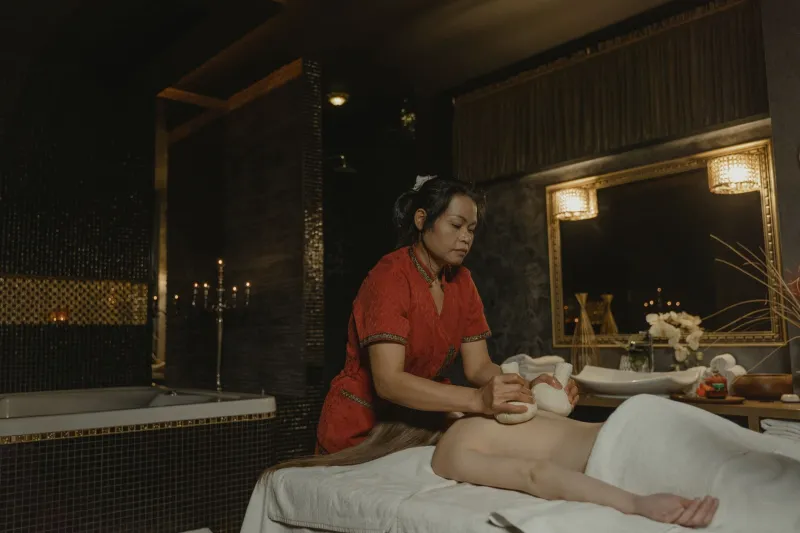
"When we work on a traveler who has just flown in from the United States, we are not just relaxing muscles," says Murat Demir, a senior therapist at a 24-hour wellness center in Beyoğlu. "We are having a conversation with the nervous system. We are telling the body: this is your new evening. This is where rest begins."
The timing of that conversation is everything.
The Counter-Intuitive Booking Window
Most travelers, if they book a massage at all, do it during normal business hours — maybe a 10 AM session after breakfast. That's actually one of the least effective windows for circadian resetting, because your body is in a phase where it's trying to reconcile two conflicting signals: your home clock says it should be the middle of the night, while daylight and activity are screaming otherwise.
Therapists at Istanbul's all-night spas have noticed a pattern among their most satisfied clients: the ones who book sessions between 11 PM and 3 AM local time — counterintuitive as that sounds — tend to report dramatically better sleep quality afterward and faster overall adjustment.
The logic tracks neurologically. If you're flying eastward from the US, your body clock is running behind Istanbul time. A deeply parasympathetic-activating massage at what feels like "late night" to your system — even if it's technically early morning in Istanbul — can help anchor that new sleep phase more efficiently than any supplement.
Mark T., a managing director at a private equity firm who travels between Chicago and Istanbul six times a year, describes the shift bluntly: "I used to lose the first two days of every trip just adjusting. A colleague told me to stop fighting it and book a late-night session instead of trying to force sleep. First time I did it, I woke up at 7 AM Istanbul time feeling genuinely rested. I've done it every trip since."
What a Reset Session Actually Looks Like
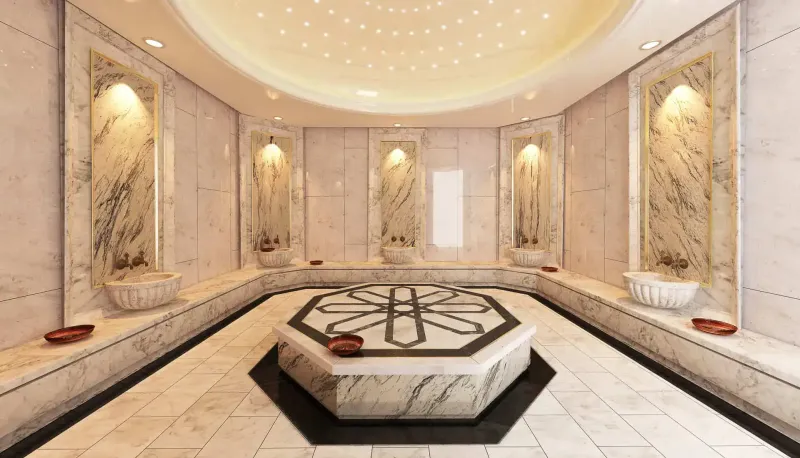
Istanbul's 24-hour wellness venues aren't just offering standard Swedish relaxation at odd hours. The therapists who work night shifts — and there's a distinct culture around this in the city — tend to specialize in what you might call "transition work." Think deep tissue work on the posterior chain (where travel tension accumulates most aggressively), combined with slow lymphatic drainage sequences and deliberate thermal contrast using the hammam's cold plunge.
That thermal contrast is significant. Moving from heated marble to cool water mimics the natural temperature arc your body uses to transition from wakefulness to sleep. Done skillfully, it's essentially a pharmacological-grade sleep-onset cue delivered without a single pill.
Sessions typically run 75 to 90 minutes and cost a fraction of what you'd spend on a comparable experience in New York or London. The availability at 2 AM isn't a gimmick — it's infrastructure that exists specifically because Istanbul has always been a transit city, a place where people arrive exhausted from every direction at every hour.
The Bigger Picture for Business Travelers
If you're routing through Istanbul regularly — or if the city is your destination — the calculus is straightforward. Three days of jet lag fog versus one strategic late-night session is not a close comparison, professionally or personally. The executives who've made this part of their travel protocol aren't doing it as a luxury indulgence. They're doing it because it works, and because the alternative is showing up to critical meetings operating at a fraction of their capacity.
Your body isn't confused because it's lazy. It's confused because it received no clear signal about where it is in time. Istanbul's night-shift therapists, whether they'd frame it in neuroscientific terms or not, have spent years learning how to send exactly that signal.
Sometimes the most productive thing you can do at 1 AM in a foreign city isn't lying in the dark counting sheep. It's getting on a table and letting someone recalibrate you.