Why a Stranger's Hands in Istanbul Just Solved the Problem Your Meditation App Has Been Ignoring for Months
The App Streak That Isn't Actually Working
You've got a 47-day streak on your mindfulness app. You've done the box breathing. You've sat through the body scans. And yet, somewhere around day 31, you started sneaking your phone into sessions because the insights just... weren't coming.
Here's the uncomfortable truth that the wellness tech industry would rather you not dwell on: passive, screen-guided meditation is a genuinely useful tool for stress reduction, but it's a surprisingly weak driver of the kind of cognitive breakthroughs most high-performing professionals are actually chasing. The neuroscience behind why is fascinating — and it points directly toward something Istanbul's round-the-clock massage culture has been doing right for centuries without needing a single algorithm.
What Your Brain Is Actually Doing During Deep Work
Neuroscientists talk a lot about the default mode network, or DMN — a cluster of brain regions that lights up when you're not focused on any specific external task. Think of it as your brain's background processing system. It's active when you're daydreaming, taking a shower, or staring out a train window. And critically, it's the network most associated with creative insight, problem reframing, and the kind of lateral thinking that makes a good strategist genuinely great.
The catch? The DMN is suppressed when you're actively following instructions. Which is exactly what you're doing when a calm voice in your earbuds tells you to "notice the sensation in your left foot" every 90 seconds.
You're not wandering. You're being directed. And directed attention, however gently applied, is still directed attention.
What Turkish Massage Therapists Do That Your App Can't
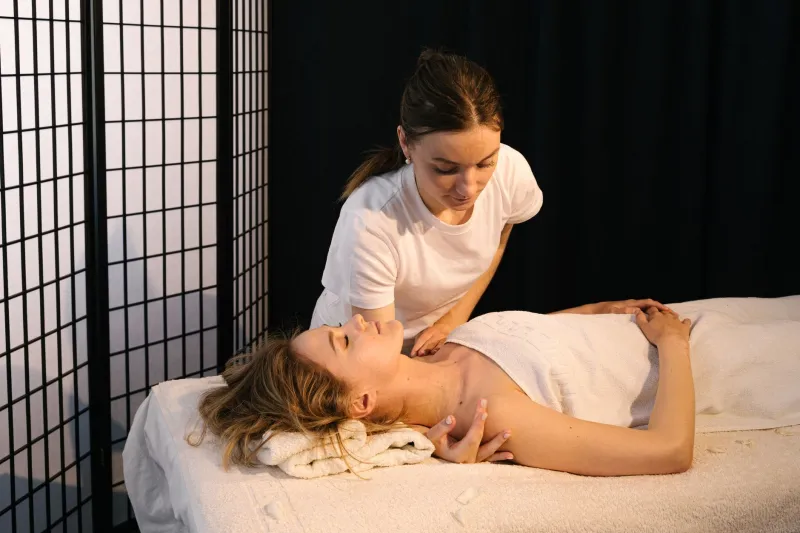
Walk into one of Istanbul's 24-hour wellness centers and something different happens from the moment you lie down on the table. A skilled therapist doesn't open a protocol on a tablet and execute it. They read you.
They start with their hands on your upper trapezius and they're already building a picture — the density of the tissue, the asymmetry between left and right, the way certain muscle groups have recruited themselves into compensatory patterns that tell a story about how you've been sitting, traveling, and stress-loading your body for the past several weeks. Before they've moved past your shoulders, they've made diagnostic decisions that no app can replicate, because those decisions require tactile intelligence that took years to develop.
That customization matters more than it might seem. Because when the treatment is genuinely responsive to your body rather than following a fixed script, your nervous system registers something important: I don't need to manage this situation. You're not following along. You're not performing relaxation. You're simply being worked on by someone who demonstrably knows more about what your body needs right now than you do.
That surrender — real, earned surrender based on competence rather than ambient music — is what finally lets the DMN off the leash.
The Physicality Piece That Silicon Valley Keeps Skipping
There's a reason so many founders and executives come back from Istanbul trips talking about ideas that suddenly clicked during a late-night session at a Bosphorus-side spa. It's not magic, and it's not the ambiance (though the ambiance doesn't hurt). It's the combination of physical input and cognitive release that the body needs to stop white-knuckling its way through problem-solving.
When a therapist works a chronically tight psoas or breaks up adhesion patterns in the thoracic spine, they're not just affecting muscle tissue. They're sending proprioceptive signals up through the nervous system that actively shift your physiological state. Heart rate variability improves. Cortisol drops. The body stops running its low-grade threat-detection loop that's been quietly burning CPU in the background of every Zoom call you've had this quarter.
At that point, your brain doesn't need to be instructed to relax. It just does. And in that gap — that genuine, unscripted gap — the DMN starts doing what it does best.
Meditation apps can approximate this. But approximation and embodied experience are not the same thing, and your nervous system knows the difference.
The Diagnostic Mirror You Didn't Know You Needed
Here's a layer that doesn't get discussed enough: the way a skilled Istanbul therapist describes what they're finding in your body often functions as a surprisingly accurate map of where your stress is actually living.
Some of the best spas here — particularly those catering to international business travelers passing through on tight schedules — employ therapists who will briefly walk you through their observations before or after a session. Not in a clinical, detached way, but conversationally. "Your right shoulder is doing all the work your left side has given up on" lands differently than any mindfulness prompt. It's specific. It's about you, right now, in your actual body, not a generalized avatar of stress.
That specificity creates a kind of reflection that passive wellness tools structurally cannot offer. And for a lot of people, that reflection becomes the doorway to thinking clearly about problems that had been stubbornly abstract.
Timing It Right in a City That Never Closes
One practical advantage Istanbul has over almost every other major city a business traveler might pass through: you can access this at 2 AM without apologizing to anyone.
Jet-lagged from a transatlantic flight and your brain is firing on all cylinders at midnight local time? That's actually not a bad moment to book a session. Your DMN, as it happens, is particularly active during the sleep-adjacent, low-external-stimulation windows that late-night travel tends to create. Pairing that neurological state with an hour of skilled manual therapy isn't a luxury indulgence — it's arguably the highest-ROI cognitive investment you can make during a layover.
The app on your phone will still be there when you land home. The 3 AM therapist in Beyoğlu who can read your body like a road map of the last six months — that's a resource worth using while you're here.
The Bottom Line for Anyone Still Counting Meditation Streaks
Nobody's saying delete the app. Consistency in any mindfulness practice builds real, measurable benefits over time, and the research on that is solid. But if you're using your streak as a proxy for cognitive performance and wondering why the insights aren't scaling with the minutes logged, it's worth asking what the practice is actually missing.
The answer, more often than not, is a body that's been genuinely heard — not by an algorithm parsing your sleep data, but by a pair of experienced hands in a city that's been in the business of physical restoration longer than most wellness brands have been incorporated.
Istanbul's 24-hour massage scene didn't build its reputation on vibes. It built it on results. And for the kind of problem-solving clarity that actually moves the needle, that distinction matters more than any app update ever will.